

How to test how much Spectre and Meltdown hurt your PC’s performance - storywiffaided1974
With manufacturers over again shipping Meltdown and Spectre updates to fix security measures exploits in CPUs, you Crataegus oxycantha be wondering just how much of a hit your PC has purloined.
After testing how much the updates affected older PCs and my own Surface Book performance laptop computer, and studying the benchmarks run by colleagues at Techspot and PCMag arsenic recovered, we believe we've found a simple right smart for the average consumer to caliber the slowdown.
 IDG
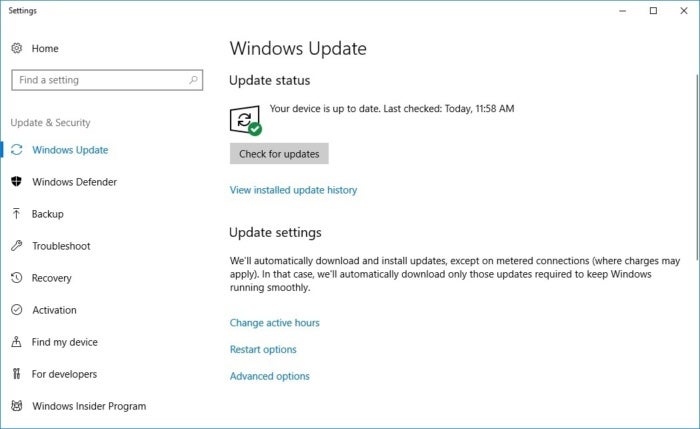
IDG Make sure you have all of the latest updates for Windows installed.
Ill-use 1: Make a point your PC is updated
Make sure your Microcomputer is updated with the latest patches for Nuclear meltdown and Ghost. If you need Thomas More details on how to do this you crapper show our news report along how to protect yourself from Meltdown/Spectre.
To verify your position, we urge that you download and run Gibson Explore's free InSpectre utility, which can verify that your motorcar is updated and amply patched. The utility program has already been updated twofold multiplication, indeed make sure to snag the a la mode version (Release 6, as of this writing). The ideal result with Release 6 should be "yes" (as in, yes, your Personal computer is protected) for both Meltdown and Spectre.
 IDG
IDG Maxon's release Cinebench R15 comes in a zip file containing thousands of files. We'll habit this to do some of our testing.
Gradation 2: Gather your materials
There are two elfin files you'll need for varied tests. Both are free.
We recommend using the free Cinebench R15.038 benchmark, which you backside download flat from Maxon.
The second benchmark file is CrystalDiskMark 6, which functions arsenic a good second opinion following Cinebench.
 IDG
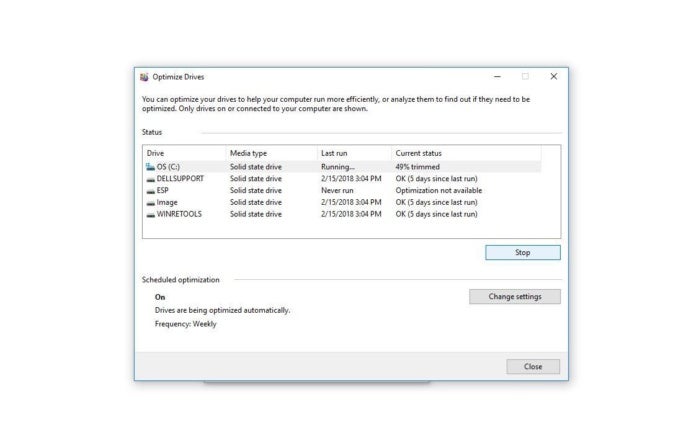
IDG You should "reduce" the SSD on the system you're about to test by using the Optimize command from Windows 10. This orders the drive to erase cells marked for deletion and testament aid in more uniform results.
Step 3: Preparation your PC
Before you manage whatever performance testing, you should take your computer offline to prevent Windows from interfering with results by deciding to download a massive update. If you're on Wi-Fi, set your PC to Plane Mode via the networking section in Windows Settings. If you're on Ethernet, just disconnect the cable television from the PC.
Much of the performance problems with Meltdown and Spectre graze dormy in disk access. If you're using a hard drive, you stern relax a little: You're unlikely to point out any impact bu because embarrassing drives are already tedious. Only if you're exploitation an SSD, you testament notice if it starts to retarding force, and these benchmarks will prove it.
We recommend that you TRIM the SSD before doing any testing. In File Internet Explorer, double-click This PC to read the main folders on your electronic computer. Right-click the icon symbolizing the primary feather OS drive (ordinarily C:) and pawl Properties. Take the Tools tab in the dialog box and click Optimize. This will order the SSD to execute housekeeping tasks so much as erasing blocks on the SSD that had been previously well-marked for deletion. Note that SSDs typically only perform house cleaning tasks when they're idle; let the computer sit for five operating room so minutes so the SSD will really invoke the passementerie command.
After the Shipshape is done, bring up the computer. When the Windows desktop appears, wait several minutes for the OS to root down before doing some testing.
 IDG
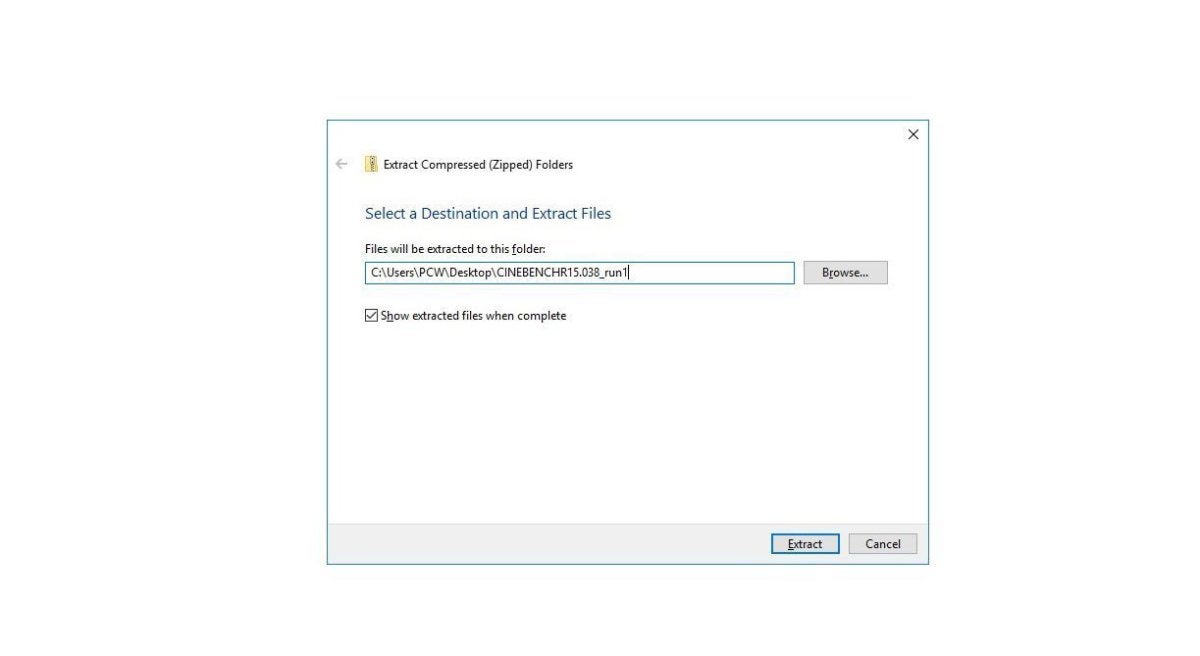
IDG Right-click on the file, and use the Windows built-in origin reinforcement. Remember to rename the folder for each run.
Step 5: Run the test
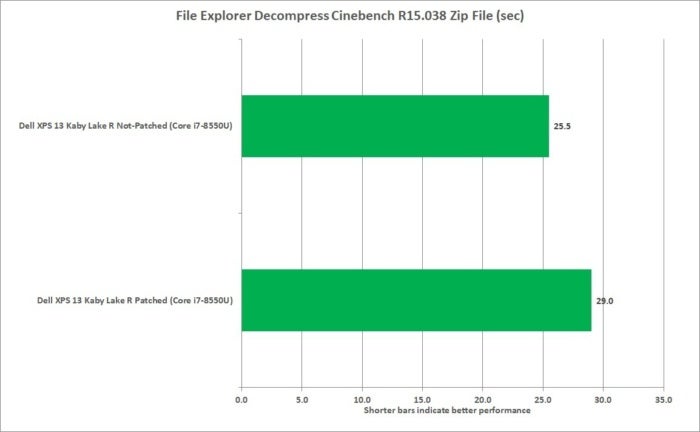
The first test is quite simple and effective: Just use Windows 10's built-in decompressing creature to unzip the Cinebench Zip file you downloaded. Cinebench R15 is an 82MB Zip file that decompresses to 202MB with 2,516 files in 126 folders. That sounds ilk a lot of files simply is pretty representative for an application, so consider IT a very real test.
Rather than deleting the folder for each run, we recommend that you simply depressurize the file into a new folder on the desktop for each run. This should give you more static results. Use a stopwatch to time each run and wait few minutes in between runs to let the machine settle. When through, take in an average of all three runs.
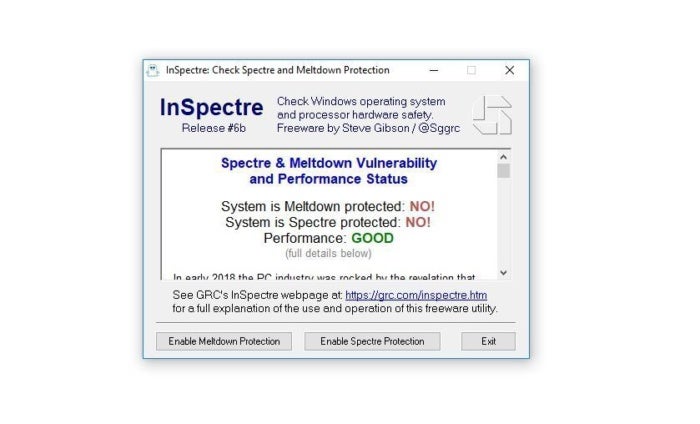
At present run InSpectre past right-clicking it and running as Administrator. You can now disable Spectre and Nuclear meltdown protection by clicking the disable buttons at the bottom of the windowpane (or enable it erstwhile you'ray done).
 IDG
IDG You can use GRC's InSpectre to toggle off Meltdown and Spectre updates in the Bone.
Once you have enabled IT or disabled IT, reboot the machine, wait several transactions for it to finalize, and re-trial your tests.
Most of the examination we've done in benchmarks shows the biggest impact to be in anything that touches the disk heavily. The performance hit in Cinebench shows up in the simple act of decompressing wholly those files. The result is, however, a great deal dependent connected the CPU. and in all likelihood the SSD too.
Step 6: Analyzing the results
On a Broadwell-based laptop with SATA-based M.2 SSDs, we've seen 30-percent swings in performance from patching. The hit isn't quite a as big on a Kaby Lake R-based laptop with an NVMe M.2 SSD, but still noteworthy at 14 percent.
 IDG
IDG The performance arrive at isn't quite as bad with a Core i7-8550U and a Toshiba XG5 NVME SSD as IT is with a Core i5-5200U and SATA M.2 drive.
Are thither strange shipway to see how much IT hurts? For one matter, with Cinebench R15, you keister now mensuration the CPU performance before and after the mend. Start the bench mark and dawn the Track down button next to the CPU button on the upper-lefthand face. It will produce a prove of how fast the particular system can render a 3D image using completely of the cores.
Be careful non to draw too many conclusions, though. Cinebench R15 and most CPU-centrical tests can buoy depart based on the temperature of the CPU. In point of fact, some brand-new laptops will also vary performance based on micro-vibrations they sensory faculty—thusly father't test it happening your lick. On a desktop with good temperature reduction, the variableness should be far less.
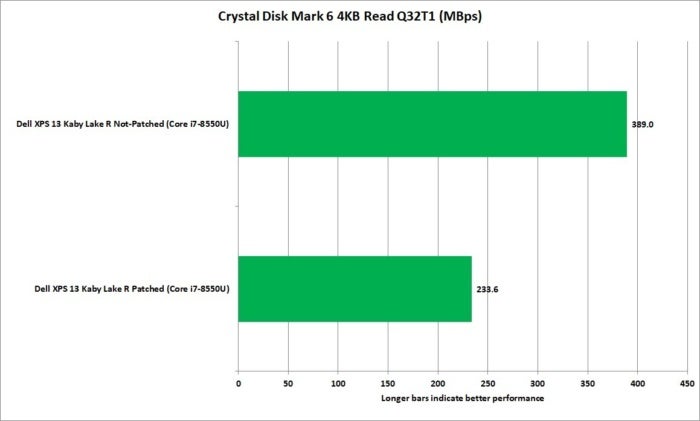
Most of the testing of consumer workloads generally puts puts the bear upon to at 3 to 5 percent. The biggest dispatch is still clearly in saucer I/O, which can crop up in any diligence or spirited. You fundament see direct evidence of this by victimization CrystalDiskMark 6.0. This is a benchmark built on an locomotive Microsoft uses to measure server disk performance. To run CrystalDiskMark 6.0, install it past running the viable and then click the All Button. If all you want to see is performance on small files with a queue depth of 32 and a singular thread, click the 4KiB Q32T1 clitoris .
 IDG
IDG Crystal Disk Mark 6 shows the large impact from the Meltdown and Spectre localisation connected an Intel Heart and soul i7-8550U flake.
We've seen similar small file performance hits in other disk tools equally well, so we think this is representative of the worst-type scenario.
The "we're still upright soaking in the rain" part of this is that you took a hit in the least. The silver lining is the Kaby Lake R CPU with a meteoric NVMe drive doesn't suffer quite As bad a slay as elderly platforms do. Even a 14 percent carrying into action lessen isn't anything to celebrate, though.

Source: https://www.pcworld.com/article/407951/how-to-test-how-much-spectre-and-meltdown-hurt-your-pcs-performance.html
Posted by: storywiffaided1974.blogspot.com
0 Response to "How to test how much Spectre and Meltdown hurt your PC’s performance - storywiffaided1974"
Post a Comment